

Macular Degeneration Glasses: What Actually Helps
If you have macular degeneration, you may have already tried the obvious thing: a new prescription that made no difference to your reading. Searching for macular degeneration glasses then turns up magnifiers, tinted lenses, telescopes and head-worn screens, all presented as though they solve the same problem. They do not, and the difference between them matters. Knowing which aid does what also makes the conversation at your next eye appointment far more productive. In this blog post, we set out what each type of aid does, which tasks it suits, and where to have the right one chosen for your eyes.
Quick Overview
- Macular degeneration damages the centre of the retina, so it affects detail rather than your whole field of view.
- A stronger glasses prescription cannot correct it, because the problem lies in the retina rather than in the focus.
- The term macular degeneration glasses covers low vision aids, which work by enlarging, brightening or shifting an image.
- No aid returns your sight to normal, and choosing one starts with having your remaining vision measured.
First, a look at what the condition changes, because that explains why the usual fix does not apply.
What Macular Degeneration Does to Your Sight
Age-related macular degeneration affects the macula, a small area at the centre of the retina. The retina is the light-sensing layer lining the back of your eye. The macula is the part of it packed with light-sensitive cells that handle fine detail.
 Because the damage sits in the centre, so do the symptoms. Vision in the middle of what you are looking at turns blurred or distorted. Straight lines can appear bent. Faces become hard to make out, colours can seem duller, and you may find yourself wanting more light than you used to.
The condition moves through early, intermediate and late stages. Vision often holds up reasonably well through the first two, which is part of why it goes unnoticed. Late-stage disease is where sight loss becomes more marked, and it takes two forms.
Dry macular degeneration develops as cells in the retina gradually die off, and a person’s central vision fades slowly. Wet macular degeneration happens when abnormal blood vessels grow beneath the retina and bleed, which can change sight suddenly. The wet form is the more serious and faster moving of the two, and dry disease can also turn wet over time. Any sudden change in central vision should be seen by an eye specialist within a week rather than at your next scheduled visit.
Why a Stronger Prescription Will Not Fix It
Reading difficulty that does not improve with new glasses is itself listed among the recognised symptoms of macular degeneration. It is not a sign that your optometrist got the prescription wrong.
Spectacle lenses adjust where incoming light comes to a point. What they cannot do is replace damaged light-sensitive cells. Those cells are what the eye needs in order to resolve fine detail. If the ones at the centre have stopped working, a sharper focus simply lands on tissue that cannot use it.
What remains is what the aids work with. This eye disease takes the centre and generally leaves the surrounding vision working. Every aid described below is built on that fact, putting the healthier retina around the damaged patch to work on jobs the centre no longer manages.
So What Are Macular Degeneration Glasses?
Macular degeneration glasses are not a product you can buy under that name. The phrase covers a broad group of devices known as low vision aids.
Low vision aids fall into three categories. Optical devices such as specialised lenses come first. Changes to your surroundings, like better lighting or high-contrast labels, come second. Electronic and digital devices make up the third. Some need a prescription, and plenty can be bought over the counter.
What none of them do is restore normal vision. Their purpose is narrower and more practical, which is to make particular tasks possible again for somebody living with visual impairment. That is worth knowing before you spend anything, because it sets a realistic bar for what any aid can achieve.
Spectacle-Based Aids You Might Be Offered
Low vision glasses are the aids worn on your face rather than held in your hand.
- Extra strong reading glasses. A far higher reading power than a standard prescription provides. Stronger lenses have a shorter working distance. That puts the comfortable focal point close to your face, so print has to be held nearer than you are used to.
- Prismatic eyeglasses. These contain a prism, a wedge of lens material that redirects light. The prism shifts the image sideways, so your peripheral vision can take in what sits directly ahead of you. They suit reading, writing and looking at photographs.
- Telescopes. Small telescopes fitted into or onto a lens, sometimes called special prescription binoculars. They bring distant detail closer, whether that is a street sign or somebody’s features from the far side of a room. They are made for use while seated, not for walking about.
- Filter lenses. Tinted lenses aimed at glare rather than at magnification, covered in more detail below.
Because these are prescription optical systems rather than shelf items, the power is worked out from your measured vision and the distance you want to work at. Two patients with the same diagnosis often end up with quite different lenses.
Magnifiers and Electronic Screens
Magnifiers are used more than any other aid, and they are also the simplest. They run from a lens in your hand to a screen on your desk.
Low vision magnifiers come as handheld, pocket, stand-mounted and clip-on versions, and sit alongside a far broader set of everyday equipment, including talking scales, raised-dot labels for jars and large-print playing cards. Many magnifiers carry their own light, which often matters as much as the enlargement does.
Electronic versions work differently. A camera and TV screen work as a pair. Point the camera at a page, and a magnified image appears on the screen in front of you. The approach grew out of the closed circuit television reading machines used for decades. The advantage over a hand lens is how much text stays visible at once. The magnification is adjustable, and multiple view modes let you flip contrast to white-on-black at the touch of a button. Desktop video magnifiers handle books, bills and craft work. Handheld units with a small screen give up screen area for portability.
A wearable device is also available, using a head-mounted display to present the same magnified view hands-free. These are newer and cost considerably more. The evidence on them is set out below.
Tinted Filter Lenses for Glare
Glare is one of the more wearing parts of macular degeneration, and it is often what prompts patients to ask about tinted lenses.
Filter lenses cut selected parts of the light spectrum. The point here is not enlargement. These lenses reduce glare, and they improve contrast between an object and its background. They also screen out UV rays, which is sound eye health practice for anybody.
Which tint suits which patient is not well settled by research, and results have varied between studies. Amber and yellow are commonly tried indoors, with darker brown or grey for outdoors. Because responses differ so much between individuals, testing several tints in the conditions you find hardest is more useful than choosing on description alone.
What the Evidence Shows
Low vision aids do produce measurable gains. The size of those gains is worth knowing.
A 2025 systematic review examining reading performance after low vision rehabilitation pooled 33 studies covering 2,611 participants with macular degeneration. Across those studies, reading speed rose from 58 words per minute to 74 words per minute after rehabilitation. The largest single gain, roughly 59 words per minute in one study, came from eccentric viewing training. That is a technique for looking a little to the side of your target, so what you want to see lands on the retina that still works.
The same review reports three findings that temper that. Set against a control group rather than against their own earlier scores, the improvement was not statistically significant. One head-mounted electronic device slowed readers down by roughly 15 words per minute. The reviewers also treated the body of evidence overall as low certainty, because a high proportion of the individual studies were at risk of bias.
None of that argues against using aids. It argues against assuming a more expensive or more technical device will automatically suit you better.
Starting With a Low Vision Assessment
An aid is matched to a measurement, not to a diagnosis, and that measurement is what decides whether a device turns out to be useful to you.
The assessment tests your visual acuity and contrast sensitivity, which together describe how much detail you can still resolve. Then comes the more important question: what are you trying to do? Reading sheet music, threading a needle and following a football or baseball game on the television call for different devices. Practice is part of it, because several of these aids take some getting used to. You would normally come away with a shortlist rather than a single recommendation, and the chance to trial devices before settling on one.
Your ophthalmologist arranges the assessment alongside your ongoing macular care, so it sits within your treatment rather than separate from it. Two changes cost nothing in the meantime. Improve the light where you read, using a directed lamp rather than relying on a ceiling fitting. And if you have an Amsler grid at home, keep using it, checking each eye on its own for lines that appear wavy or a patch that has gone missing.
Book an Eye Check at Our Clinic
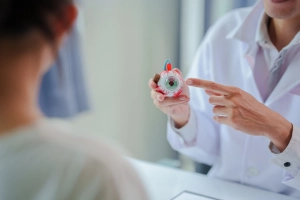 Aids and the disease itself are two separate jobs: a magnifier can make today’s newspaper readable, but it has no effect on what is happening in your retina. That matters particularly with wet AMD, where sight can change within days, so a sudden distortion warrants a call rather than a refraction.
At Mornington Peninsula Eye Clinic, our retinal ophthalmologists diagnose and manage macular disease using retinal imaging and intravitreal injections, and can advise on home monitoring between visits. If your central vision has changed, or macular degeneration runs in your family and you are due for a check, we are glad to help. To arrange a consultation at our eye clinic, please call us on (03) 9070 3580.
Frequently Asked Questions
Should I keep wearing my usual glasses if I have low vision aids?
Yes, in nearly all cases. Your regular prescription still corrects any short- or long-sightedness you have, which an aid does not do. Several aids, including clip-on magnifiers and some prism lenses, are designed to work together with your own glasses rather than instead of them.
Does the lighting at home make much difference?
More than you might expect, and it costs nothing to change. A directed lamp placed to the side of your reading material, rather than behind you, lifts contrast without adding glare. Getting the lighting right sometimes reduces how much magnification you end up needing at all.
How does a low vision assessment fit with my regular eye appointments?
They run alongside each other rather than replacing one another. Your appointments here monitor the disease and manage any treatment, while the assessment works out which aids suit the tasks you want to get back to. Raising it at a review is a simple way to start. Bringing your recent results along means the assessor is not starting from scratch on measurements you have already had taken.
Will macular degeneration cause severe vision loss?
Central vision loss is what reading, driving and recognising faces depend on, so the practical impact can be considerable. The vision around the edges usually keeps working, which is why many patients continue living independently. How far it goes depends on the type and stage, and that is a question for your eye specialist rather than a general rule.
How often should I have eye tests if macular degeneration runs in my family?
Family history is one of the recognised risk factors for developing AMD, alongside smoking and age, so it is worth raising at every appointment. Your interval is set on your own examination findings rather than on family history alone. Nutritional supplements sometimes come up in the same conversation, and whether they apply to your stage is worth asking directly.
Can I wear low vision glasses all day, or only for certain tasks?
Nearly all of them are made for specific tasks rather than general wear. Extra strong reading glasses and spectacle-mounted magnifiers have a very short working distance, so they suit sitting down with print rather than moving about. Telescopic lenses are the same, intended for a seated activity. Tinted filter lenses are the exception, and those can be worn continuously.
Any surgical or invasive procedure carries risks. Before proceeding, you should seek a second opinion from an appropriately qualified health practitioner.
References
https://www.medicalnewstoday.com/articles/macular-degeneration-glasses
https://www.aihw.gov.au/reports/eye-health/eye-health/contents/about



Leave a Reply
Want to join the discussion?Feel free to contribute!